Rodrigo Jorge · Prepared October 12, 2026, at 6:04 a.m. Brasília time (UTC-3). Publication time to be confirmed.
In the demo, the operator shuts down the agent and messages stop appearing on screen. That proves the interface stopped. Does the API still accept the credential the agent was using?
This is a test scenario, not an incident report. As a CISO, I would ask for that check before authorizing an agent to make changes to the environment. A kill switch is meant to stop its ability to act. A confirmation in the dashboard does not, on its own, show that this happened.
Existing session, new credential
The AWS IAM documentation provides a concrete example of this distinction. When revoking a role's sessions, AWS applies the AWSRevokeOlderSessions policy, with a cutoff based on when the credentials were issued. Sessions issued after the cutoff are not covered by that denial. AWS also documents delays in the propagation of IAM changes.
This is not evidence of an agent failure or a rule for every platform. It is the documented behavior of a revocation mechanism. For an agent using that mechanism, the operational implication is straightforward: revoking earlier sessions also requires checking whether the agent is still authorized to obtain new ones.
These are two separate tests. Using the existing session, attempt an operation that was previously allowed. Then try to obtain a new session through the path the integration actually uses. A denial in the first test does not answer the second question. Use a dedicated identity and lab resources for these tests, and keep credentials out of the logs.
The work may already be running elsewhere
Consider a workflow that submits a job to another service. Once that service accepts the request, stopping the process that submitted it may leave the job running. This is an architectural possibility, not a behavior established for every service.
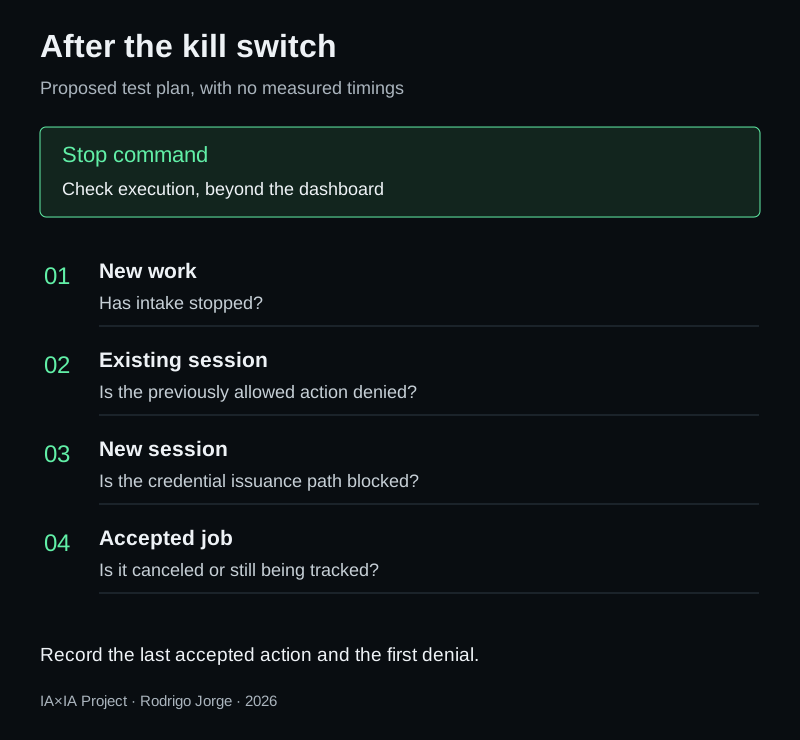
That is why I propose checking three things in a shutdown test: new work stops entering the system; credentials already issued no longer authorize the intended action; and jobs accepted by another service are identified and handled according to its available cancellation mechanism.
There is no need to ask a model to judge these conditions. Evidence can come from API responses, queue state, and execution logs. Whoever is responsible for the shutdown needs access to that evidence even if the agent is unavailable or compromised.
View the diagram: what to check after triggering the kill switch. A conceptual test sequence, with no measured timings.
What I would ask to see in the review
A record of when the stop command was issued, the last action accepted, and the first denial observed. It should also show the attempt to renew the session and what happened to pending jobs. If policy changes take time to propagate, measure that interval in the actual environment. This article does not specify a universal shutdown deadline.
The test also needs to reveal who else was affected. Revoking sessions for a shared role can interrupt other users. Separate identities for each integration help contain that impact, but do not remove the need to check effective permissions.
The decision to let the agent operate should account for what can still happen during that interval and what has already been executed. A completed action needs assessment and, where possible, recovery. The kill switch cannot undo the past.
References
- AWS IAM: Revoke IAM role temporary security credentials, documentation accessed October 12, 2026. Scope of revocation and impact on users of the role.
- AWS IAM: Changes that I make are not always immediately visible, documentation accessed October 12, 2026. Propagation and verification of changes.