Rodrigo Jorge · Prepared October 20, 2026, at 11:49 a.m. Brasília time (UTC-3). Publication time to be confirmed.
An alert points to a Pod. The agent gathers evidence and proposes deleting it. While the decision awaits execution, that Pod is deleted and another is created with the same name. The pending command still says to delete that name.
This is a hypothetical scenario. No classification error is needed for the action to hit the wrong object. The context became stale between analysis and execution.
The Kubernetes documentation distinguishes names from UIDs. A name can be reused after deletion; each object created receives a distinct UID. For a response integration, the implication is straightforward: keeping only the name and namespace does not preserve the identity of the object that was assessed.
As a CISO, I would ask to see what gets passed to the executor. Does it receive only “delete Pod analise,” or does it also receive the identity of the object whose deletion was authorized? The names in this example are illustrative, not production identifiers.
The condition needs to reach the API
Kubernetes provides a specific mechanism for this check: DeleteOptions.preconditions, with fields for UID and resourceVersion. The reference documents that an unmet precondition prevents deletion and returns 409 Conflict.
In this scenario, a deletion conditioned on the original UID should not remove the replacement with a different UID. That does not make the decision to delete correct. It prevents a target substitution that a command based only on the name would not detect.
For the playbook, I propose recording the cluster, resource type, namespace, name, and observed UID alongside the action. The executor should pass the condition to the API through a path whose semantics have been verified. Looking up the UID, comparing it in code, and then sending an unconditional delete request is not enough: the object can still change between the lookup and the request.
View the diagram: the name stays the same, but the identity changes. A conceptual example with abbreviated identifiers, not incident data.
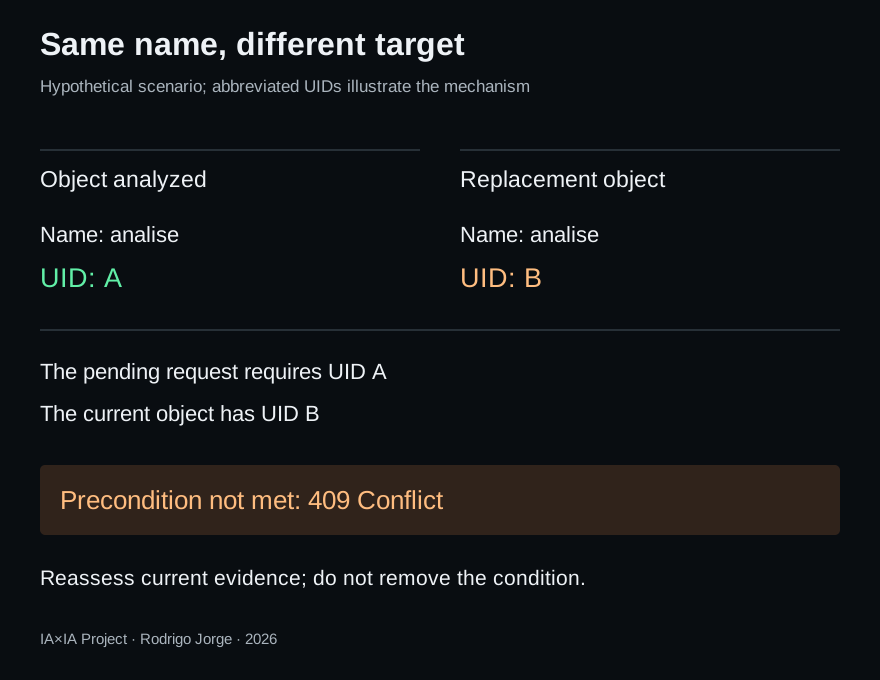
The UID distinguishes objects, but does not establish that the same object is still in the state that was assessed. If the decision depends on that state, an appropriate version condition also needs to be evaluated for the operation. Fields named “version” in other APIs do not necessarily have the same semantics.
A rejected condition should send the workflow back to an assessment of current evidence. It is not a reason to remove the condition and retry. The new assessment can be automated if that class of action has already been delegated; human approval is not mandatory for every change. What should never happen silently is the transfer of authorization to another target.
The lab test belongs between decision and execution: replace a test object with another that has the same name, execute the old command with the precondition, and verify that the replacement remains. Keeping the request sent and the response lets the team check whether the integration actually preserved the condition.
Before authorizing this workflow, I would require evidence of which object was assessed and which one the call could affect. “The name matches” leaves that question unanswered.
References
- Kubernetes: Object Names and IDs, accessed October 18, 2026.
- Kubernetes API: DeleteOptions and Preconditions, accessed October 18, 2026.